



because positivistic science cannot derive a value from a fact or even recognize values as real, we have a science of administration which can deal only with facts and which does so by eliminating from its consideration all human passion, weakness, strength, conviction, hope, will, pity, frailty, altruism, courage, vice, and virtue (p. 61).
Greenfield created a change in educational thinking that forced many researchers to consider aspects of their research that should move beyond the realm of purely scientific measurable facts. The questions put forth encouraged others to ask questions about the human element or as Greenfield (1986) described, “the moral dilemma”(p.63) of educational administration. According to Manley-Casimir (2003), “Greenfield restored the focus on the people in organizations, the human agents without whom the organization would have no existence” (p. 260).
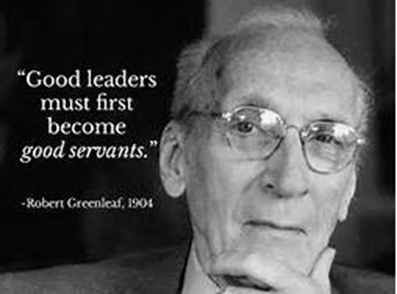
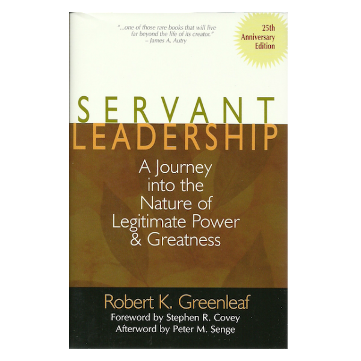
Robert Greenleaf (1977) advanced leadership studies from the scientific focus of positivism in Servant Leadership. Servant leadership focuses the administrator “on service to others and recognition that the role of organizations is to create people who can build a better tomorrow” (Paris & Peachey, 2012, p. 378). The servant leader, as expressed by Greenleaf, moves beyond a style of leadership into a way of life that determines every aspect of an administrator’s decision-making processes. At the centre of this theory is a focus on humility and self-sacrifice that puts others above the individual self. Authentic leaders, according to Greenleaf, earn the allegiance of others by building trusting relationships. According to Duignan & Bhindi, “Authentic leaders are aware of their own limitations, are tolerant of imperfection in others, and help others learn, grow, mature and succeed” (p. 206). The fundamental assessment of a servant leader can be explored in the questions: do those around them grow as an individual? Did they become “healthier, wiser, freer, more autonomous, more likely themselves to see leadership as service” (Greenleaf, 1977, p. 13 as cited by Duignan & Bhindi, 1997, p. 206)?


Building on the work of Greenfield and Greenleaf, Henderson & Hoy (1982) began to measure aspects of authentic leadership. In their study, they looked at the perception of principal authenticity from the perspective of teachers. Their study concluded that “the authentic leader is viewed as one who treats subordinates with respect and demonstrates a consistency of expressions and actions, while the inauthentic leader is perceived as dealing with subordinates as if they were things” (Henderson & Hoy, 1982, p. 5 as cited by Duignan, 2014, p. 156). This perception is vital in linking the importance of maintaining a healthy school climate. Leaders who are perceived as authentic, are able to more effectively bring together staff and students and move them towards a professional climate which promotes learning and respect. According to Fullan (2002), “if relationships improve, schools get better. If relationships remain the same or get worse…leaders are able to build relationships because they are aware of their own emotional make-up and are sensitive and inspiring to others” (p. 18).
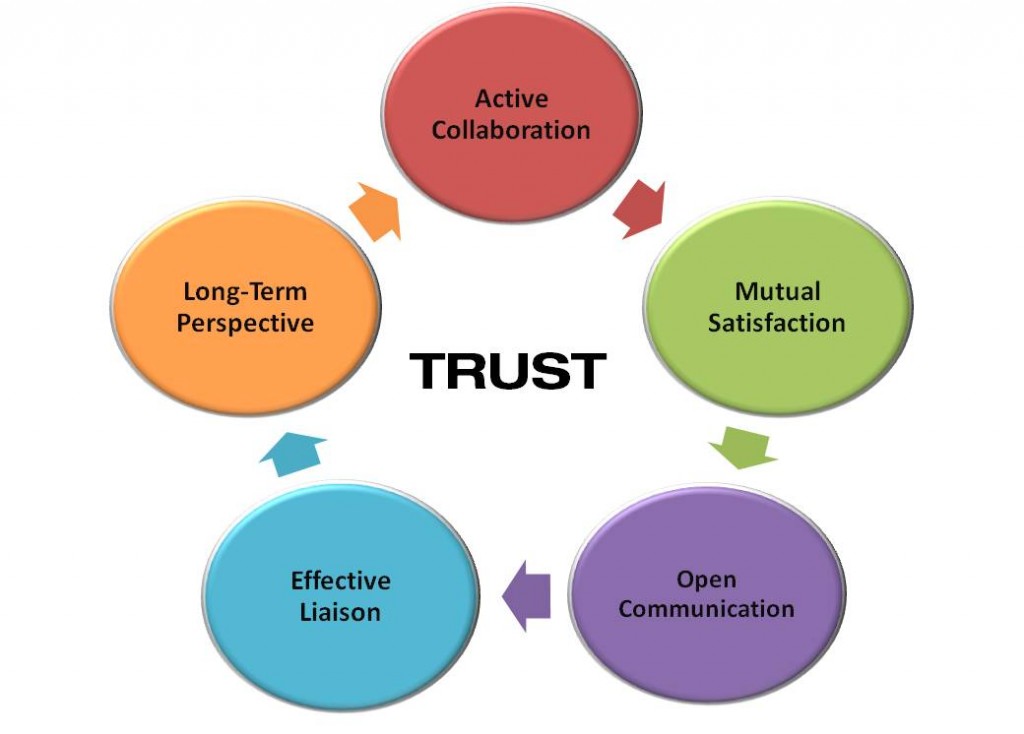
Authentic leadership, as a field of study, took another step forward with C. Hodgkinson’s book The Philosphy of Leadership (1983). Hodgkinson (1983) argues that administrative leadership is a philosophy-in-action. In other words, all “leadership is intrinsically valuational”. Leadership has to be grounded in values in order to give the leader a direction from which to lead the organization. Hodgkinson (1991) further argues that education has “an idealistic and humanistic quality which renders it distinctive and special among the occupations and callings” (p. 23) which makes it vitally important to be grounded in values that promotes the human spirit. Hodgkinson (1991) refers to the human spirit as “truth, beauty, goodness, justice, happiness, and self-fulfillment” (p. 17). Education should not be viewed as the learning of facts and ideas; it should be viewed as inspiring others to search out the truth as to what it means to be human. This belief should be present in both leaders and learners.

C. Taylor (1991) further pushed the idea of authentic leadership when he proposed that the ideal of authenticity is when a moral force is motivating the individual. Taylor (1991) argues “we should not be afraid of the effort required to develop an understanding of the higher good. Morality and the good require a re-centering of our focus from the primacy of survival to the transcendent good” (Meynell, 2011, p. 205). This argument is a call to move beyond the small details that seem to drag down individuals and rather encourage them to become more concerned about the bigger picture and the impact of one’s behaviour on those around them. Taylor’s (1991) arguments call for a closer relationship with those around us in order to facilitate a stronger perception of our own identity because “the genesis of the human mind is […] not ‘monological’, not something each accomplishes on his or her own, but dialogical” (Taylor, 1991, p. 33). According to Duignan & Bhindi (1997), “the quality of the relationships greatly influences everything else that happens in organizations, including the quality of leadership” (p. 201). The interactions between the leader and the group creates “interrelationships, interdependency and mutuality of interests” which has the ability to create the effective relationships that drives the organization (p. 201).

Building on the connections between individuals as stated in the previous paragraph, R. Terry (1993) further added to Taylor’s (1991) arguments by concluding that relationships should be authentic and be grounded in actions. Terry (1993) states “authenticity informs and directs action, action grounds authenticity in life. Without authenticity, action drifts. Without action, authenticity remains idle conjecture and wishful thinking” (p. 138). Leaders should be perceived as being action/risk takers within an educational organization, than being perceived as being weak and a push over.

R. Starratt (1993) further encouraged leaders to pursue action and values as part of their leadership methodology. When trying to expose the inherit cynicism towards the managerial approach of many leaders, Starratt (1993) stated “the cure rests with human beings deciding to recapture their life-world as a humanly fulfilling journey” (p. 84). This statement attempts to reconceptualise the relationship between leaders and subordinates into one that is caring and respectful and that promotes equal respect and honesty between all members in an organization. Starratt (1993) further argues that authenticity in leadership “is desperately needed. It must be … grounded in the sober understandings and memories gained at such a cost in human lives and suffering” (p. 136). Leaders should have feelings and should be connected to those with whom they are supposed to be leading. Leadership, according to Starratt (1993), should be able to see its failures and shortcomings and be grounded in a reality of responsiveness to those within an organization. An authentic leader should recognize their inabilities and find mechanisms and individuals who can help overcome any challenge the leader may have.